
The AI in industry is no longer just a laboratory promise; it has become a business lever. At the University of Cantabria’s Summer Course in Laredo, speakers from Deduce Data Solutions and other experts shared how it is genuinely applied: with real cases, with limits, and with quotes worth keeping.
If you work in production, logistics, quality or management, you’ve probably already asked yourself: where do I even start with artificial intelligence without getting lost in the noise? We’ve gathered the most valuable ideas shared about AI in industry, organised by topic. This isn’t abstract theory: it’s what works (and what doesn’t) when you take AI from the test notebook to the plant floor.
What You’ll Find Here
- Understand Before Optimising
- What Generative AI Is (and Isn’t)
- Machine Vision on the Factory Floor
- From Data to Decision
- From No-Code to “Vibe Coding” and Agents
- From “Sketch” to Production: MLOps
- Talking to Your Documents
- AI Is Also a Legal Matter
- Deploying Doesn’t Mean Forgetting
- Where Should You Start?
01. Understand Before Optimising
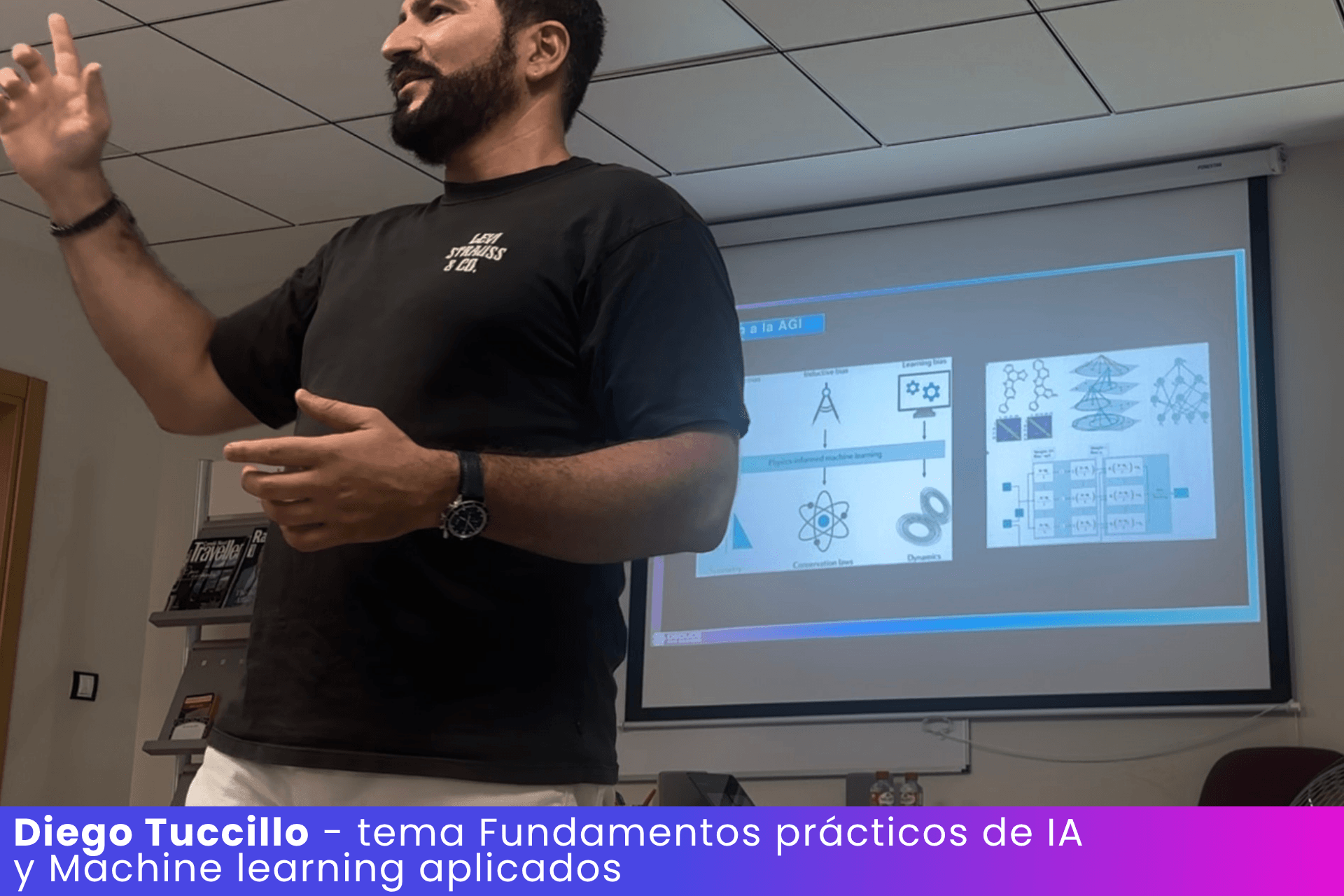
The opening session was led by Diego Tuccillo, of Deduce Data Solutions, who set the tone for the whole course. His opening message was as direct as it was uncomfortable: AI in industry is no longer optional.
Either you implement it, or you get left behind, with every disadvantage that implies. Diego Tuccillo, Deduce Data Solutions
But Diego steered clear of the easy pitch. Against the usual hype, he argued for starting with what the technology still can’t do: before selling AI, you also have to state its limits. That honesty is precisely what separates a project that survives in production from a demo that impresses on a Tuesday and collapses on a Thursday.
He also explained, very visually, why people and machines learn differently: once we understand the rules of something, we stop making mistakes; a model, by contrast, needs thousands of examples and only knows what it has been taught. Hence the motto DDS uses to sum up its way of working, and which runs through this article: understand before optimising. First understand the process and the data; then automate.
Key Takeaway
Adopting AI in industry isn’t about replacing people, it’s about properly understanding the problem. If you don’t understand the process, AI will only speed up your mistakes.
02. What Generative AI Is (and Isn’t)

Steven van Vaerenbergh, of the University of Cantabria, took apart some of the magic. A language model doesn’t “think”: it predicts the next piece of text based on an architecture called Transformers, which since 2017 has turned images and words into tokens that the machine processes. His overview of image generation left one widely quoted line: “we’ve gone from six fingers to a quality that’s almost indistinguishable”, and a practical rule of thumb that fits industry perfectly:
Use AI when verifying the result is cheaper than producing it by hand. Steven van Vaerenbergh, University of Cantabria
03. Machine Vision on the Factory Floor
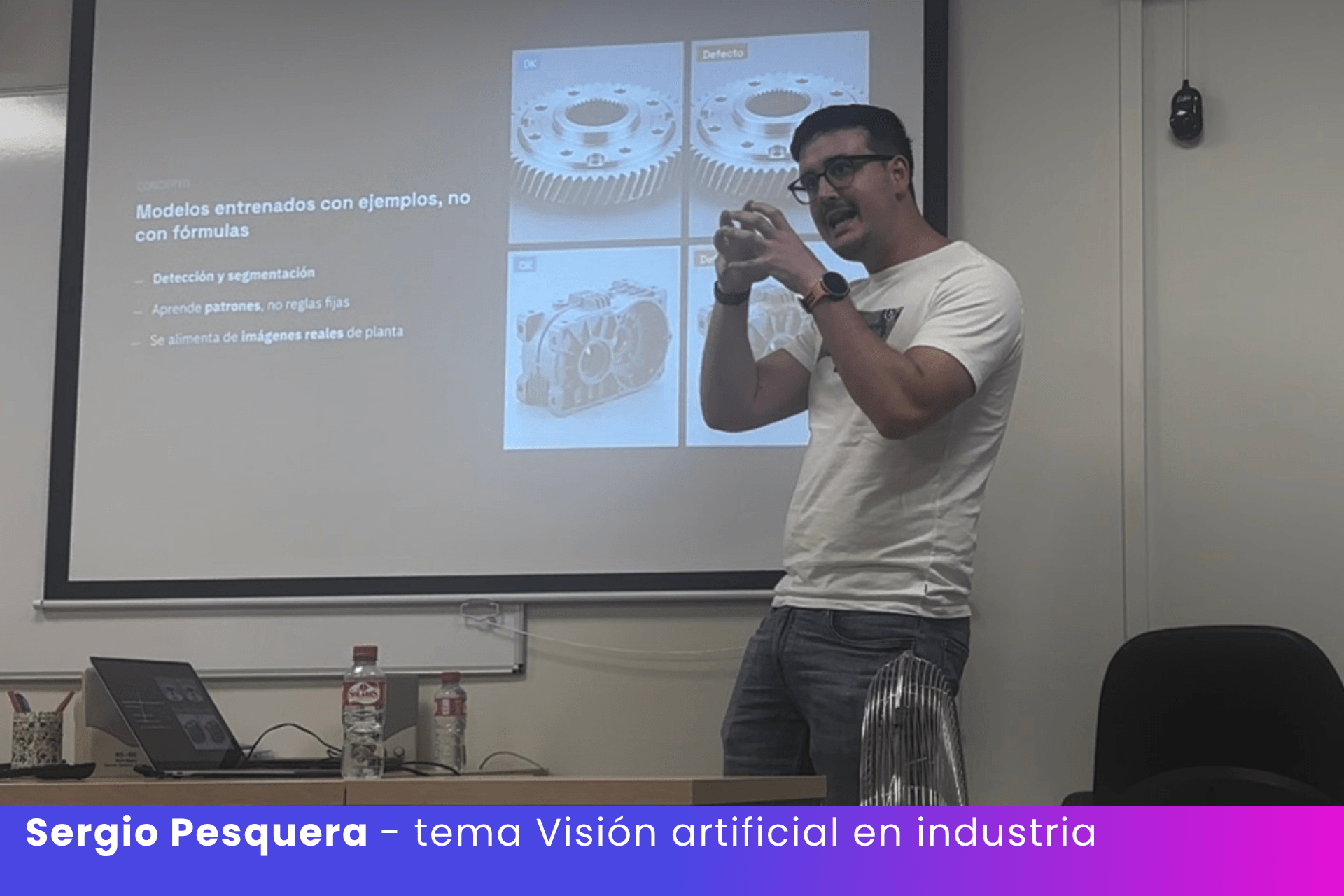
Sergio Pesquera, of Siali (Santander), brought AI down to the plant floor with machine vision: cameras that carry out quality control on production lines. His best explanation was a domestic analogy: “my daughter recognises that’s a cat even if it’s missing a leg; teaching a machine to do the same takes an enormous amount of variety.” The conclusion applies to any project: a model’s reliability depends directly on the quality and variety of the data it’s trained on. And when it works, the impact is tangible:
We’ve gone from a cost measured in engineer-hours to a cost measured in operator-hours. Sergio Pesquera, Siali
04. From Data to Decision
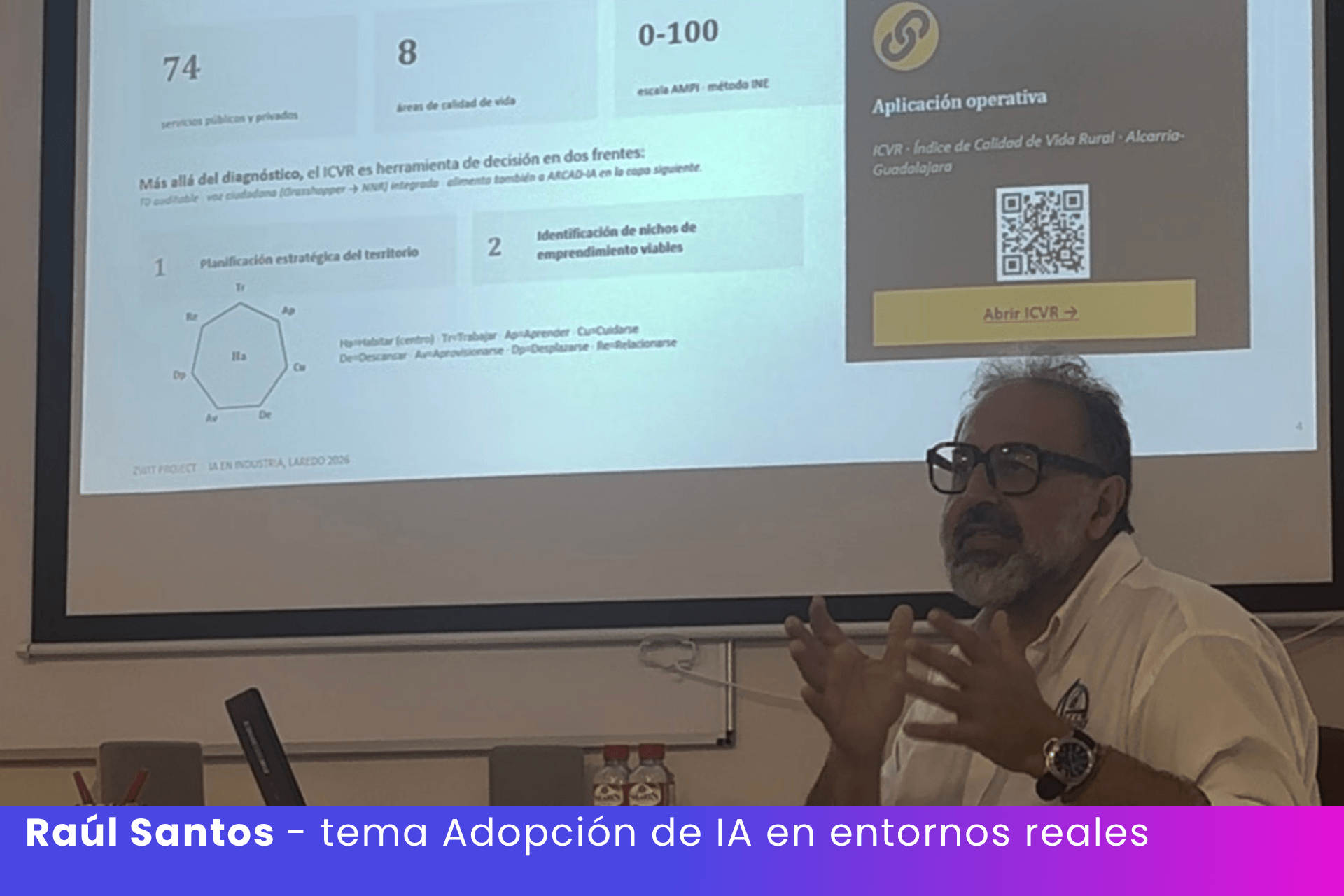
Raúl Santos, CEO of Zwit Project, lifted the view from the workshop floor to the wider territory: technology isn’t the end goal. The key isn’t installing more sensors or having more platforms.
Technology exists to serve people, not the other way round. Raúl Santos, CEO of Zwit Project
His argument connects with the heart of AI in industry: moving from intuition to evidence.
Santos illustrated this with fifteen years of work in rural territory, summed up in one line: «Spain doesn’t have a demographic problem, it has a territorial-architecture problem.»
That’s where the TRI (Smart Rural Territory) was born, recognised in 2018 by the European Parliament as a case study in Smart Eco-Social Villages, before AI was even part of the system.
AI came in later, layer by layer: the ICVR measures the real distance to 74 essential services per municipality and, through the IVN (Niche Viability Index), its inverse reading, cross-referencing that shortfall with real demographic mass, identifies viable entrepreneurship niches wherever a service is missing and the population can sustain it.
ARCAD-IA cross-references that signal with official and citizen data to turn it into an investment case; Rural Mind brings the service to the citizen, with a conversational assistant and a local marketplace already active in Cantabria.
It’s the same logic that underpins AI in industry: turning a scattered piece of data into a well-founded decision.
As a production-proven example, he cited Rural Care 360: 280 active users across four autonomous communities, using a tablet and voice-based conversational AI instead of a mobile app: 72% of older people don’t use a smartphone (CSIC, 2025).
Today the model operates in five districts across four autonomous communities. Santos put forward, as an open hypothesis, that the same architecture (measure, analyse, act on a scattered system) could be transferred to any dispersed industrial operation. It is, at bottom, another way of looking at AI in industry: measure first, so you can decide.
05. From No-Code to “Vibe Coding” and Agents
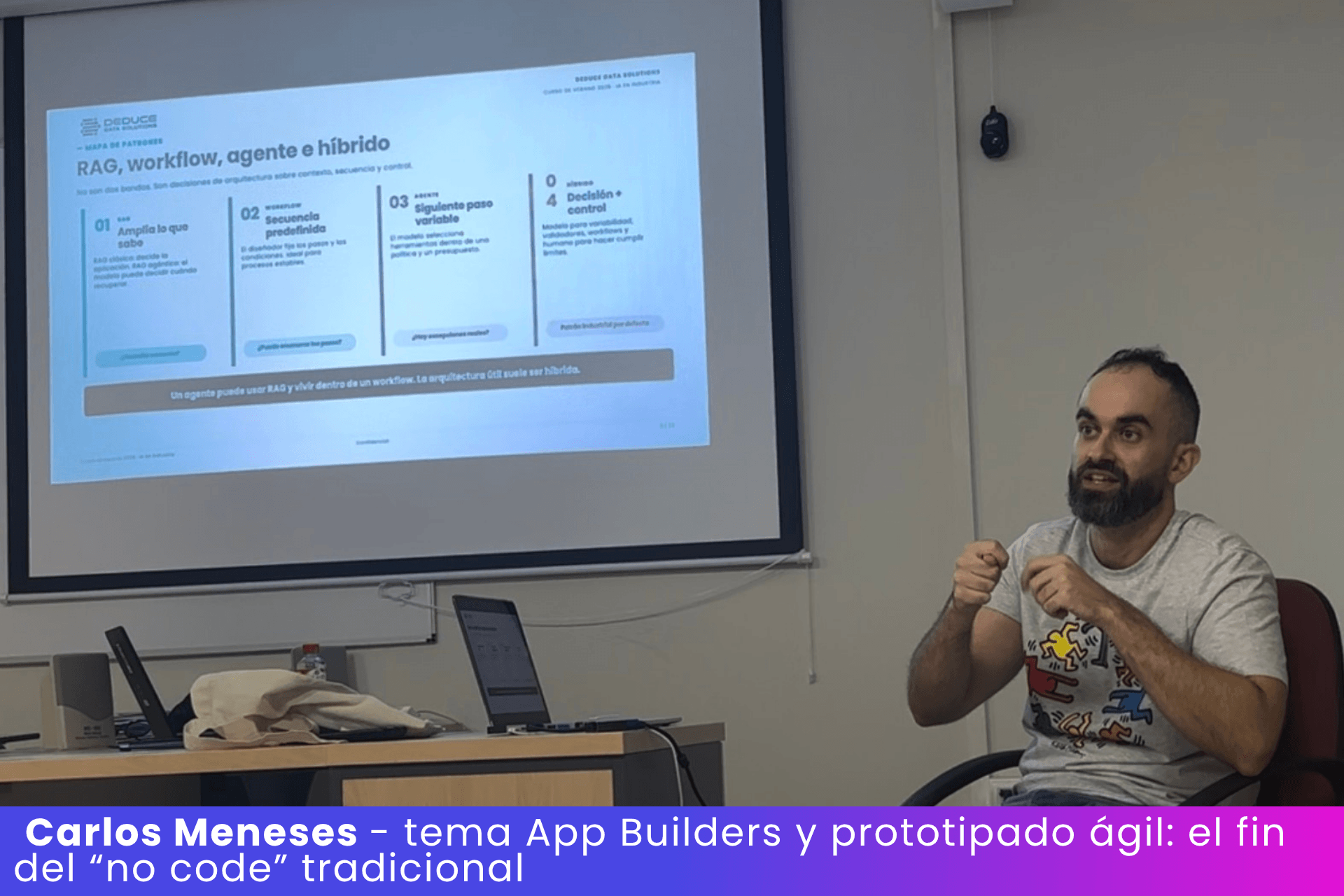
One of the most hands-on sessions was led by Carlos, an expert in building AI-based solutions. He traced the evolution of the tools: from no-code boxes-and-flows to AI-assisted development, the so-called “vibe coding”. Why has everything changed? For a simple reason:
The most human interface there is, is natural language. That’s why the traditional box-and-flow tools have become obsolete. Carlos, AI development expert
That said, he warned of a classic danger: the machine is literal. If you don’t set the limits, it will invent its own; which is why you have to be very strict with your specifications. He also left a golden tip for anyone starting out: each family of models responds differently. Anthropic’s models perform best with goals and few instructions; OpenAI’s GPT models, with very well-defined instructions; and the Gemini family excels at creative writing.
And he explained the risk of trusting AI with everything, using an example that got a laugh: you ask it to “change slide 9 for me” and it hands back the whole presentation changed. The lesson is that you have to know how to verify. On agents, he gave a definition that strips away the mystery:
An agent is like a contract (the definition of a function) that needs rules and guardrails to always be fulfilled. Carlos, AI development expert
The rest isn’t magic: an agent runs a loop (detects an event, decides, applies a policy, respects constraints and acts) and, when the decision is critical, there must always be human feedback in the loop.
06. From “Sketch” to Production: MLOps
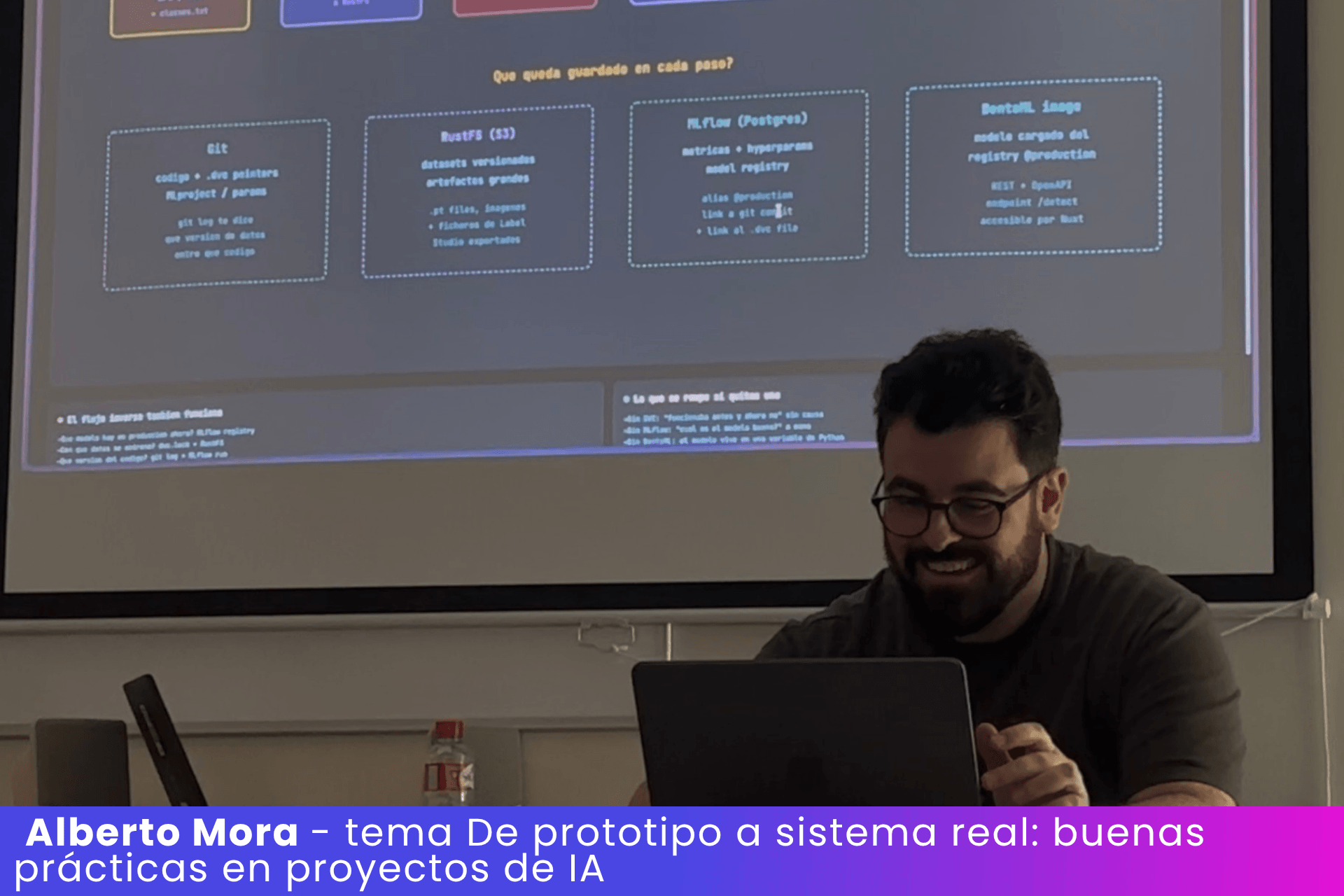
This is where one of the central talks came in, given by Alberto Mora, Head of Infrastructure at Deduce Data Solutions. His starting point is the distinction most companies discover too late:
A model trained in a notebook is just a sketch. Taking it to production means surrounding it with tooling: versioning, logging, observability and retraining. Alberto Mora, Head of Infrastructure, Deduce Data Solutions
Mora broke down the MLOps “stack” that underpins any serious AI in industry project, piece by piece: version control for the code, but also for the data and for the models (Git alone isn’t enough); storage for large files; an API to “serve” the model to a website or another tool; a labelling system; and containers (Docker) so that what works on your laptop works the same way on the client’s server. As he summed it up: “the classic ‘it works on my machine’ ends with Docker.”
Two of his ideas are worth an entire consultancy engagement. The first, on what really determines the quality of a system:
Good models live off good data alone. Alberto Mora, Head of Infrastructure, Deduce Data Solutions
The second, an efficiency trick that changes the numbers on any project: assisted labelling. Instead of labelling 10,000 images by hand, you train a small model, let it pre-label them, and you only correct it. The reduction in work is by orders of magnitude. And another hygiene reminder that companies often forget, at a high cost: never upload your keys or API keys to a repository; they’re managed separately, outside the code.
Key Takeaway
90% of the success of an AI in industry project isn’t in the algorithm, but in the engineering around it and in the quality of the data. That’s where an eye-catching pilot turns into, or fails to turn into, a reliable system.
07. Talking to Your Documents
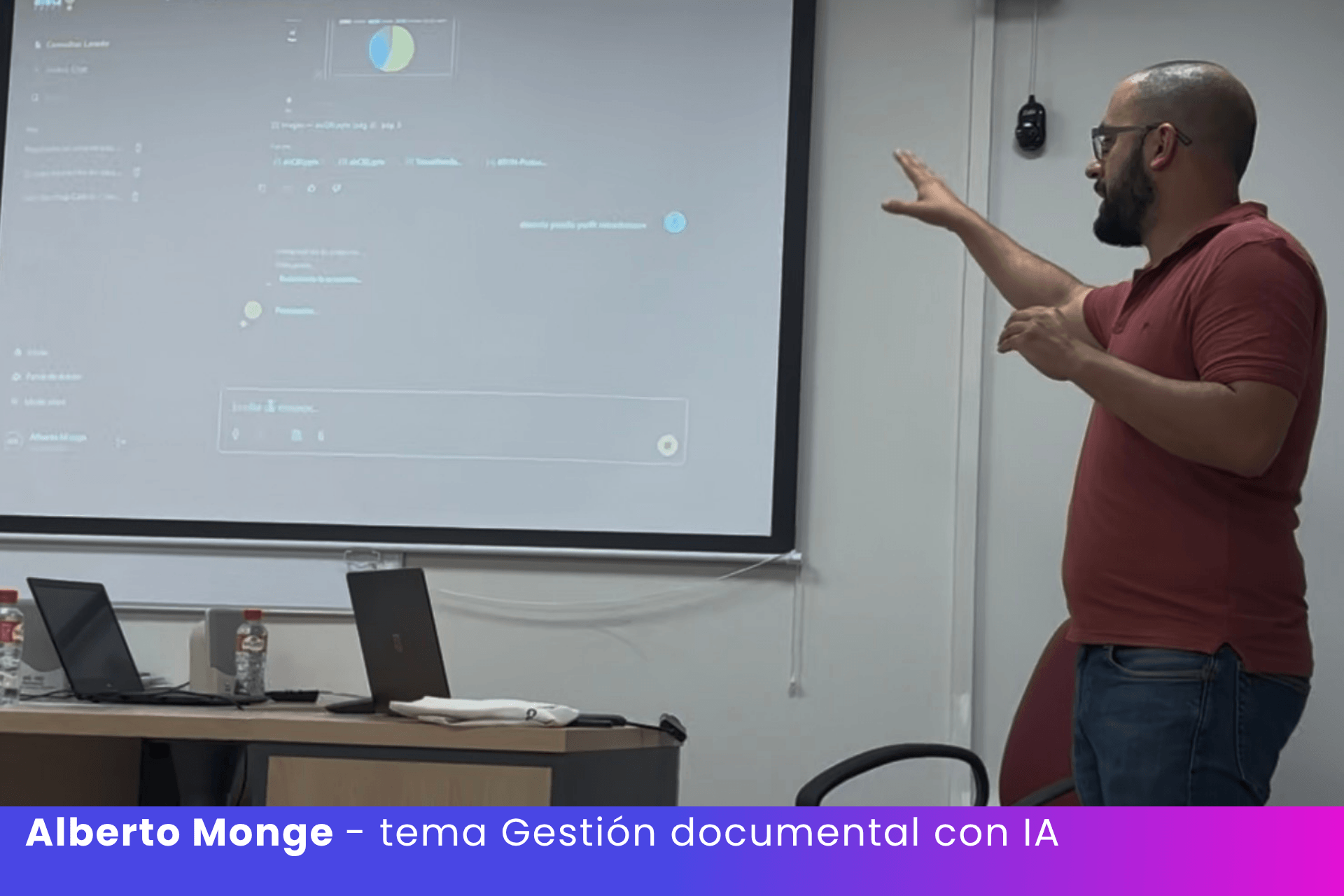
The course also made room for a problem every organisation suffers from and almost no one measures: document chaos. A large share of a company’s information is estimated to live in unstructured documents, and finding it eats up enormous amounts of time. Generative AI, using techniques such as RAG (retrieval-augmented generation), makes it possible to “talk” to your documents: instead of storing a photograph of a 200-page contract, the system understands what it’s about, summarises it and answers by citing the source. An approach presented by Alberto Monge, of LIS Data Solutions, which reinforces a theme running through the whole course: without data sovereignty and good data governance (where it resides, who can access it and with what permissions) there is no sustainable AI project.
08. AI Is Also a Legal Matter
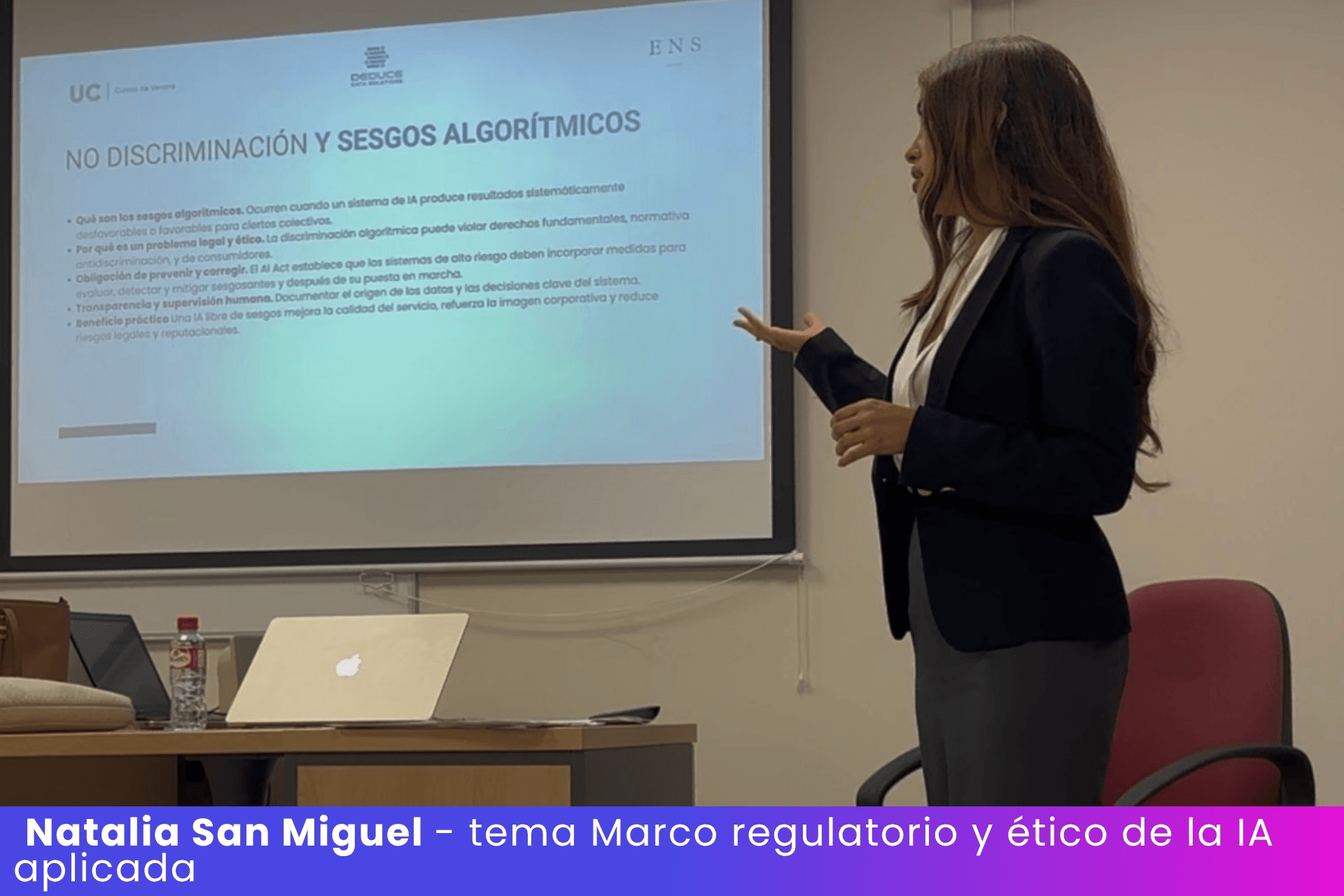
The legal segment, led by Natalia, of ENS Legal, was a reminder of something that gets forgotten in the technological euphoria:
AI is no longer just a technological matter. It’s a matter of governance and fundamental rights. Natalia, ENS Legal
She explained that the European AI Act (the first of its kind in the world) is organised by risk level (unacceptable, high, limited and minimal), and that most industrial uses fall into “high risk”: machine safety, vision systems that stop a production line, vehicles. That means risk management, documentation and conformity assessment. And the underlying reason?
A human error affects a handful of people. An AI can affect millions. Scale is what worries people most. Natalia, ENS Legal
She also warned about algorithmic bias (AI learns from historical data and reproduces its prejudices, as happened in recruitment processes at large companies) and gave a useful definition of transparency: it’s not about revealing the code, but about disclosing how the system works, what its limits are, and what data it was trained on.
09. Deploying Doesn’t Mean Forgetting
The closing session was again led by Diego Tuccillo (Deduce Data Solutions), with a hands-on exercise: a fictional company deploys an AI system to cut the running costs of an industrial furnace. At first, the savings are significant; but month by month they fade away until the system ends up spending more than before. The moral? An AI project that saves costs today may stop doing so tomorrow if no one keeps watch over it.
AI isn’t “deploy and forget.” It has to be monitored, measured and adjusted continuously. Diego Tuccillo, Deduce Data Solutions
The exercise forced attendees to choose, with a limited budget, between auditing the model’s quality, reviewing the data, or recalibrating the system. Exactly the kind of decision that separates an AI in industry project that matures from one that gets abandoned after six months.
10. Where Should You Start With AI in Industry?
If one thing became clear across all the talks, it’s that AI in industry doesn’t start with the algorithm, but with the data and the problem. Here’s the roadmap that emerges from the course:
- Get your data in order first. Without a data strategy and governance, trying to use AI is like trying to run before you can walk.
- Pick a specific use case. A repetitive process that’s currently eating your time delivers more value than one big, vague project.
- Understand before optimising. Understand the process and its real problems before automating anything.
- Think about production from day one. Versioning, traceability, observability and human feedback: what makes a pilot survive.
- Monitor and comply. Measure continuously, protect the data, and comply with the European AI Act.
In Summary: How to Approach AI in Industry
These ten takeaways from the Summer Course paint the same picture: AI in industry doesn’t start with the model, but with understanding the process, the data and the decision you’re trying to improve. AI in industry works when each piece (machine vision, generative AI, document management, agents or MLOps) answers a real, measurable problem, and not the other way round.
If the gathering in Laredo made one thing clear, it’s that applying AI in industry is as much a technical challenge as an organisational and legal one. Starting with a well-scoped case, taking care of data governance, and taking prototypes to production with traceability is the most reliable path for AI in industry to move from promise to sustainable results. At Deduce Data Solutions we support that AI-in-industry journey from start to finish.
Want to Apply AI in Your Industrial Company?
At Deduce Data Solutions we help you move from “sketch” to a real project, with data governance and compliance from day one.
Let’s talk about your caseFrequently Asked Questions About AI in Industry
What Is AI in Industry?
It’s the application of artificial intelligence to industrial processes (quality control with machine vision, predictive maintenance, document management, supply chain optimisation or agents that act on information) to make better decisions and reduce operational workload.
Where Do I Start Implementing AI in My Company?
With the data, and with a specific use case. Before training any model, it’s worth having a data strategy and governance in place, choosing a process that currently eats up a lot of time, and properly understanding that process. Then you automate it and take it to production with versioning and traceability.
Is AI Safe With My Company’s Confidential Data?
It can be, if it’s designed with data sovereignty in mind: hosting within the European Union, role-based permissions, and models that aren’t trained on your information. It’s one of the points carrying increasing weight in AI-in-industry projects.
Does European Regulation Hold Back the Use of AI in Industry?
It doesn’t prohibit it, it organises it by risk level. Most industrial uses are “high risk” and require documentation, risk management and transparency. Complying by design avoids penalties and protects people.
Will AI Replace Industrial Workers?
The approach put forward during the course was a different one: AI frees people from repetitive tasks so they can spend their time on what adds value, always with human feedback on critical decisions.
Which Sectors Benefit Most From AI in Industry?
Practically any activity with intensive physical or documentary processes. AI in industry adds value in manufacturing, metallurgy, food, logistics or energy, especially wherever there is visual inspection, equipment maintenance, heavy technical documentation, or repetitive decisions that today rely on the experience of just a few people.
Do I Need a Lot of Data to Apply AI in Industry?
Not always. Some AI-in-industry use cases, such as reading documents or decision analytics, work with the information the company already generates. Others, such as machine vision, require representative images of the process. What matters is data quality and governance, not accumulating volume for its own sake.
How Long Does It Take for an AI-in-Industry Project to Deliver Results?
A well-scoped AI-in-industry pilot usually shows signals within a few weeks, while stable production deployment with MLOps and traceability takes longer. That’s why it’s worth starting with a specific AI-in-industry case, measuring its impact, and scaling only once the value is proven.
In Summary: AI in industry works when it’s built on good data, designed for production, monitored, and governed with legal and ethical judgement. Or, as was repeated throughout the course: understand before optimising.