
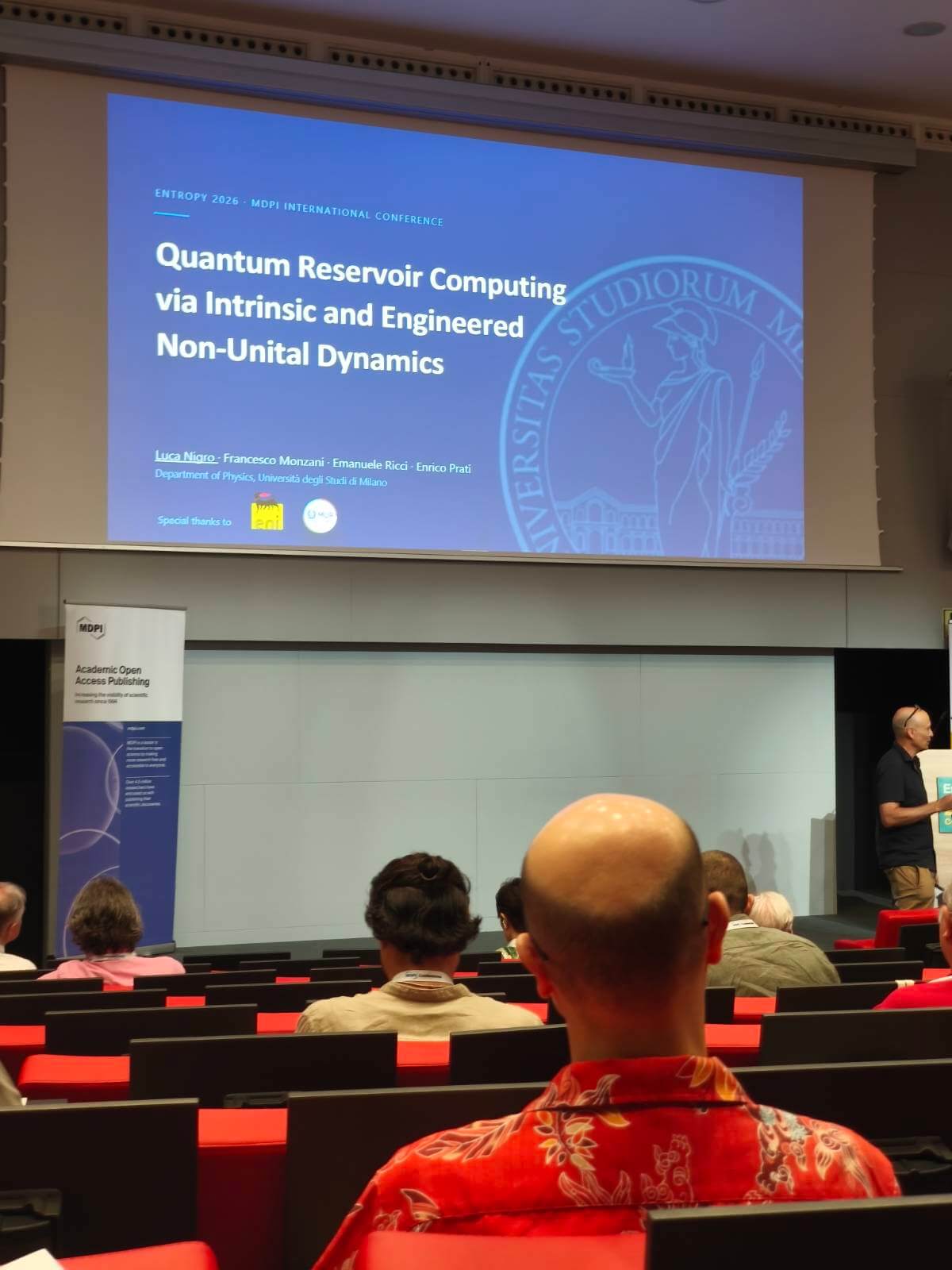
Deduce Data Solutions took its industrial AI research to Barcelona. The company took part in early July in Entropy 2026: Exploring Complexity and Information in Science, the international congress of the scientific journal Entropy (MDPI publisher), held from 1 to 3 July at the Barcelona School of Management. There, the scientific team presented a poster on applying industrial AI to a real metallurgical process: monitoring a holding-and-casting furnace.
The work addressed an increasingly relevant question in any industrial AI project: when it is worth incorporating a process’s physical knowledge into a neural network’s training, and when data alone is already enough. A seemingly technical question that, in practice, decides how much instrumentation a plant needs before it can trust a model.
1 An International Congress on Complexity and Information
The event is a landmark gathering for those who study entropy and information as cross-cutting tools of science. Besides the talk sessions, the programme included poster sessions, a special issue in the Entropy journal itself, and awards for the best oral and poster contributions. The presence of an applied company like Deduce Data Solutions at a forum of this kind is unusual, and reflects a clear intent: to test, against the academic community, the methods that later carry over into real industrial AI projects on the plant floor.
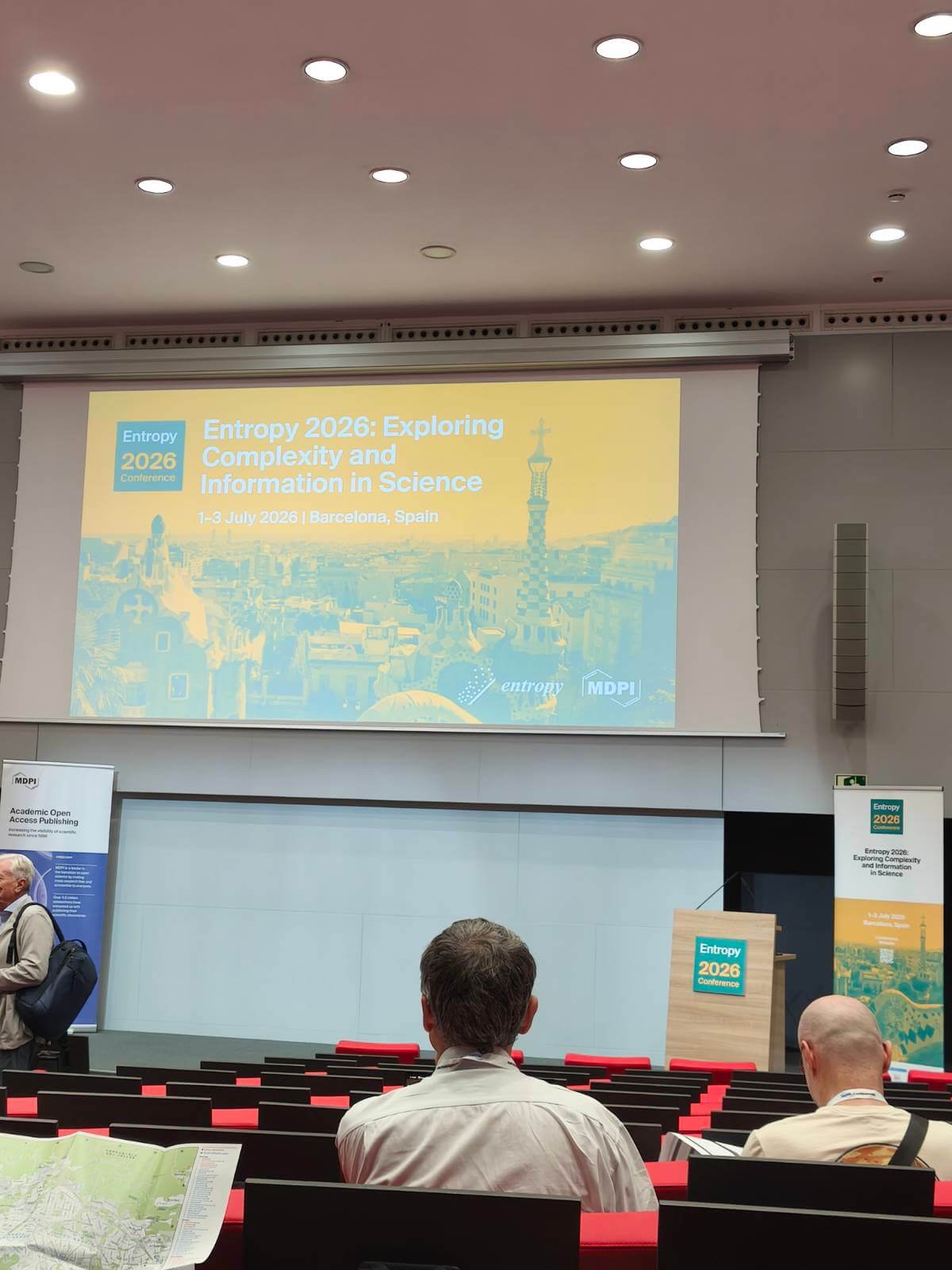
Entropy 2026 brought together, over three days in Barcelona, the community working at the frontier between physics, information theory and data science. The congress was chaired by professors Miguel Rubí (University of Barcelona) and Kevin H. Knuth (University at Albany), and organised its sessions around eight major areas.
Those areas included information theory, data science and artificial intelligence, thermodynamics and energy systems, and applications of entropy in science and engineering. It is precisely at that intersection (process physics and machine learning) that the industrial AI work Deduce Data Solutions brought to the event sits.
The 2026 edition was held at the Barcelona School of Management, in the heart of the Eixample district, once again positioning the city as a meeting point for physicists, mathematicians, statisticians and data scientists from dozens of countries. The congress’s common thread is entropy understood in the broad sense: as a measure of uncertainty and information in systems of every kind.
That focus explains why a piece of industrial AI work applied to a furnace fits naturally into the programme. Predicting the temperature of a metal bath with scarce data is, at bottom, a question of information: how much is in the data, how much the physics adds, and how the two combine to reduce the uncertainty of the prediction. In terms of industrial AI, the congress also featured publication of the best contributions and recognition for the standout posters, an incentive that raises the bar and turns participation into a real test before peers from the international scientific community.
For a company based in Cantabria with international ambitions, taking part in an event of this calibre also carries strategic value. It allows the team to measure its own work against the scientific community’s yardstick, spot areas for improvement, and build contacts with research groups that may later translate into collaborations or new industrial AI projects.
The Congress, in Brief
Entropy 2026 was held from 1 to 3 July at the Barcelona School of Management, organised by the journal Entropy (MDPI). It brought together the international community of physics, information theory and data science around eight major thematic areas, with talk sessions, posters and awards for the best contributions.
2 The Poster: Industrial AI Applied to a Casting Furnace
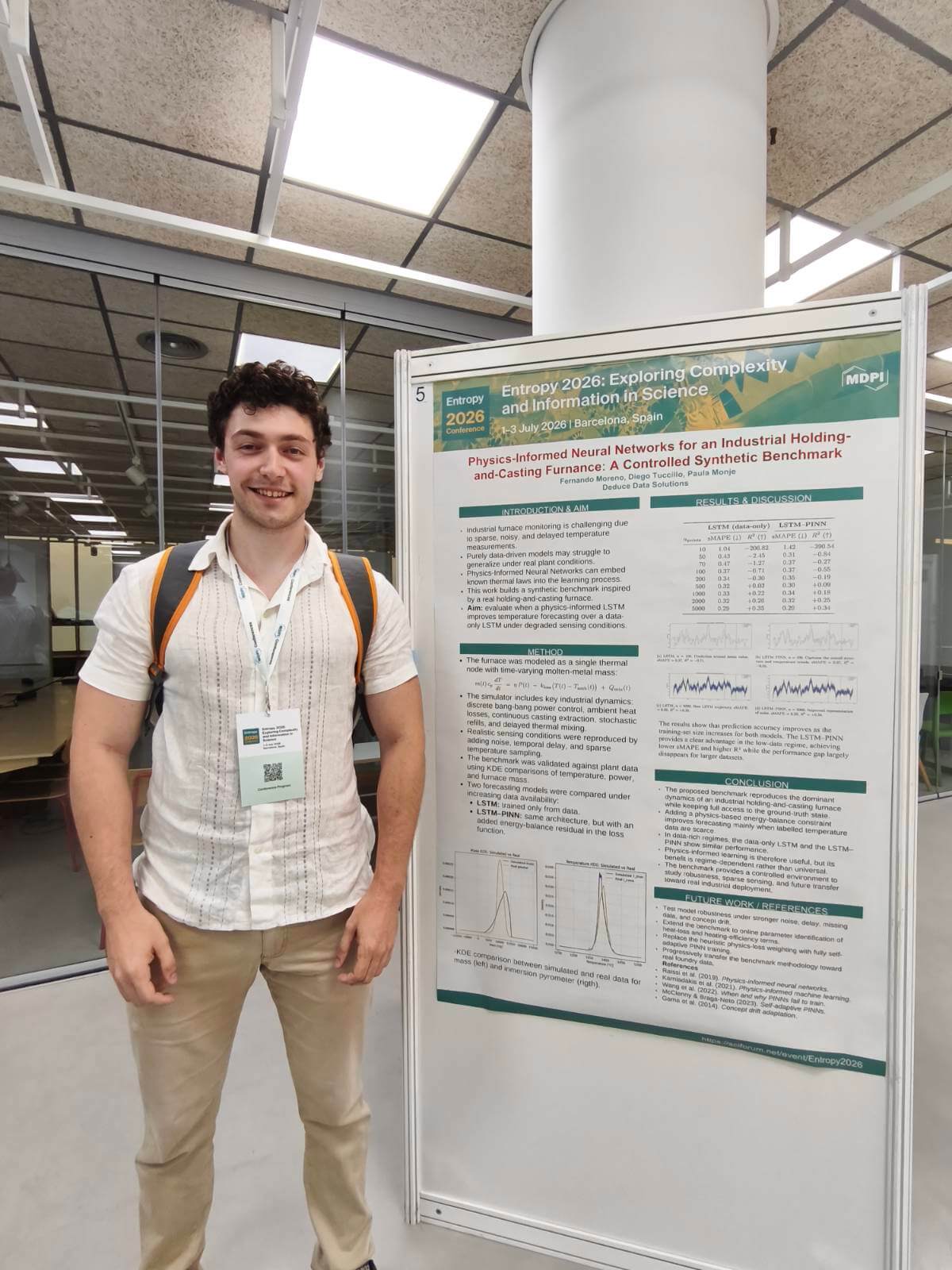
The work presented is titled «Physics-Informed Neural Networks for an Industrial Holding-and-Casting Furnace: A Controlled Synthetic Benchmark». It was authored by Fernando Moreno, data scientist at Deduce Data Solutions and PhD student, together with Diego Tuccillo and Paula Monje. The starting point is a very real industrial AI problem. A holding-and-casting furnace keeps molten metal at working temperature and draws it off continuously, but measuring that temperature well is difficult: it is done with an immersion pyrometer, a single-point, intrusive and infrequent measurement that also arrives with some delay.
The result is scarce, noisy and lagging data. In industrial AI, data quality drives almost everything, and in that context a purely data-driven model tends to give up: it predicts a flat line around the mean value and little else. Preparing that data well is a recurring challenge in any serious project, as we noted when discussing industrial data ahead of AI.
Against that backdrop, physics-informed neural networks fold the process’s thermal laws (in this case, the furnace’s energy balance) into the model’s own training. The study’s hypothesis is that this «physical compass» is especially valuable when data is lacking, and that its advantage fades once data becomes abundant.
It’s worth explaining what that «physics» added to the model actually means. A conventional neural network learns only from examples: it is shown inputs and outputs and adjusts its parameters to reproduce them. A physics-informed network, by contrast, is also given a rule it must respect (here, the furnace’s energy balance) and is penalised when its prediction breaks it.
The advantage is intuitive. When there are many examples, the network learns well from data alone; when they are scarce, that physical rule acts as a guide that keeps the model from losing its way. It’s an idea that, applied with judgement, fits squarely into the practice of industrial AI, where labelled data is usually the most expensive resource.
The measurement detail helps explain the challenge. Bath temperature is obtained with an immersion pyrometer, an instrument inserted momentarily into the molten metal that provides readings spaced out over time, with noise and delay. It is not a sensor that reports continuously, but an occasional snapshot of a process that never stops changing.
What’s more, the real furnace is not a placid system: power is switched on and off, metal is drawn off for casting, it is topped up irregularly, and the bath takes time to homogenise its temperature. The simulator built by the team reproduced all of these dynamics, so that the learning conditions resembled those of a plant rather than an idealised laboratory.
To make sure the simulator was credible, the team compared the temperature, power and mass distributions of the synthetic furnace with those of real data. The overlap was good for temperature and reasonable for mass, which gives confidence in later carrying the test bench’s conclusions over to the real process.
3 What the Work Demonstrated
The study itself leaves several lines open for continuation: stress-testing the models under heavier noise, longer delays and missing data; identifying furnace parameters such as heat losses in real time; and, above all, progressively transferring the simulator’s methodology to real foundry data, the true test of any method of this kind.
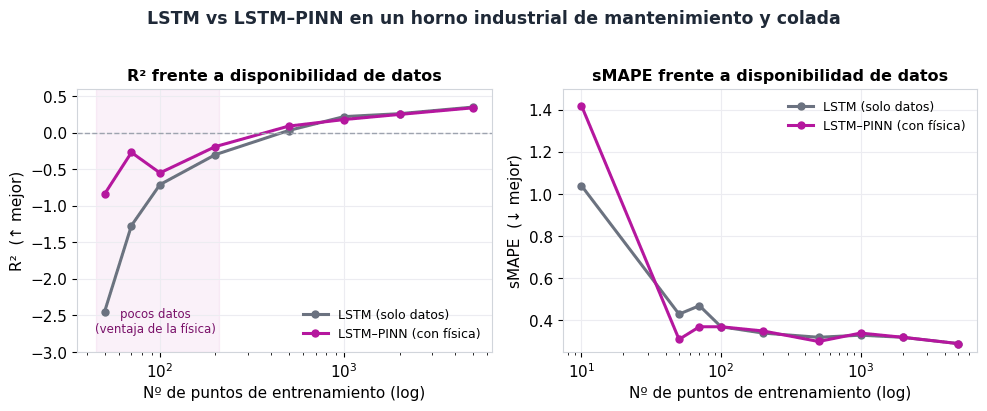
To measure performance, the study relied on two complementary indicators. One measures prediction error (how far the model deviates from the real temperature) and the other, how much of the process’s variability it is able to explain. With little data, the physics-informed model reduced the error appreciably; with plenty of data, both approaches matched each other’s performance.
The takeaway for the metallurgical sector is direct. Instrumenting a furnace with more sensors is expensive, and it doesn’t always pay off. A test bench like this one makes it possible to estimate, before investing, how much improvement to expect from each additional measurement point, a typical decision in well-framed industrial AI.
To answer this rigorously, the team built a synthetic test bench inspired by a real furnace. Rather than validating the method directly on plant data (where the full true state is never known), the simulator reproduces the dominant industrial dynamics (power control, heat losses, extraction through casting, top-ups and thermal mixing) while keeping full access to ground truth.
On that environment, two models with identical recurrent architecture were compared: one trained on data alone and another with an added physical energy-balance constraint. The conclusion is nuanced and honest, unusual in the discourse around industrial AI: incorporating physics improves prediction mainly when labelled data is scarce, and that advantage all but disappears once data is plentiful.
In other words, the benefit of physics-informed learning is regime-dependent, not universal. For industry, that turns an architecture decision into a practical, measurable question: how much quality data do I actually have before investing in more instrumentation? That is the kind of judgement that separates useful industrial AI from an empty promise.
The comparison, a very instructive one for explaining industrial AI, was done cleanly. Both models started from the same architecture and the same degraded data; the only difference was that physical constraint. So any difference in performance can be attributed unambiguously to the physical knowledge added, rather than to one model being bigger or better tuned than the other. The results traced a very instructive curve. With just a few dozen measurements, the physics-informed model clearly cut the error and explained the temperature’s evolution better. As data increased, that gap gradually closed until it disappeared, and with thousands of measurements both approaches performed practically the same.
For a foundry, the conclusion is actionable. Before spending on more sensors or costly measurement campaigns, a test bench like this one makes it possible to estimate how much would actually be gained, and to decide with data whether that investment is worthwhile. This is industrial AI put to work on a concrete economic decision.
The chosen architecture was not arbitrary either. A furnace’s temperature depends on its recent history (on the power applied minutes earlier, on the last casting or the last top-up), so the team used a network type with memory, able to take the time sequence into account rather than just the present instant. It’s a common choice when industrial AI deals with processes that have inertia.
The study builds on a well-established line of research in recent years, physics-informed machine learning, which seeks precisely to combine the rigour of physical models with the flexibility of neural networks. Applying it to a concrete metallurgical case is a way of testing what that combination really delivers outside a purely theoretical setting.
It’s worth pausing on what a negative value means in the metric that measures prediction quality. When a model scores that value, it means it predicts worse than simply repeating the mean of the observed temperature. That is exactly what happened to the model without physics when data was very scarce, and exactly what the physics helped correct in that regime.
That nuance matters, to avoid overly triumphant readings. Physics does not turn an impossible problem into a solved one: with extremely scarce data, both approaches failed. What it does is make better use of the little information available in the intermediate range, which is where many real industrial AI projects operate.
4 Industrial AI With Judgement: Understanding Before Optimising
Beyond the specific result, taking part in the congress fits with the company’s trajectory, which combines work with industrial and energy companies with a steady presence in the scientific field. That two-footed stance (academia and the plant floor) is, for the team, the best guarantee that the methods it proposes work outside the lab. The work is also part of Fernando Moreno’s doctoral research line, combining his role as data scientist with developing machine learning methods applied to industrial processes. It’s a sign of the scientific profile the company builds into its team.
The poster is a concrete example of how Deduce Data Solutions understands industrial AI: understanding a process’s physical roots before attempting to optimise it. It’s the same logic behind how the company approaches AI applied to energy efficiency: measure and understand first, decide afterwards.
Bringing this research to an international forum like Entropy 2026 reinforces the company’s commitment to uniting scientific rigour and industrial application. The maturity of industrial AI doesn’t come from promising that an algorithm solves everything, but from knowing exactly when it adds value and when it doesn’t, and sharing that transparently with the scientific community. With this participation, Deduce Data Solutions consolidates a track record of presence at congresses and scientific committees that runs alongside its commercial work in industrial AI, and reaffirms its conviction that the best technology for industry is the kind built on a solid scientific foundation.
Participation in Entropy 2026 adds to Deduce Data Solutions’ presence at other scientific forums and committees, a constant the company claims as part of its identity. Against a market saturated with promises about artificial intelligence, the company champions an industrial AI that is verifiable, tested, and explained honestly, including its limits.
Looking ahead, the team plans to carry the simulator’s methodology over to real foundry data and refine how data and physics are balanced during training. The ultimate goal is for these techniques to leave the test bench and reach the plant floor, which is where industrial AI truly proves its worth.
At a time when artificial intelligence dominates the headlines, industrial AI work like this is a reminder that the real value isn’t in the flashiest algorithm, but in understanding the physical problem you’re trying to solve. That is, in essence, the value proposition Deduce Data Solutions brought to Barcelona, and the one behind its way of doing industrial AI.
The case illustrates well an idea the company repeats to its industrial clients: before automating or optimising a process with industrial AI, it pays to understand it. A model that ignores the system’s physics can work in industrial AI while conditions don’t change, but becomes fragile as soon as the plant departs from what the model saw during training.
That’s why the work presented in Barcelona is not just an academic exercise, but a statement of method. The industrial AI that Deduce Data Solutions champions starts from process knowledge, combines it with the available data, and honestly measures when each ingredient adds value and when it doesn’t. That is the standard the company wanted to put on the table before the Entropy 2026 community.
Having people with research training within an applied team is precisely what makes it possible to tackle problems like this with confidence. Combining day-to-day practice with clients and a pulse on the latest research helps solutions go beyond the surface of the data and reach the root of the process.
Looking ahead to the coming months, the company will keep combining its commercial activity with this kind of scientific contribution. It’s a way of building long-term credibility and demonstrating, with facts, that behind its talk about industrial AI there is method, evidence and a very clear idea of what each tool is for.
In Summary
- In industrial AI, physics helps mainly when labelled data is scarce.
- With plenty of data, a data-only model performs as well as one with physics.
- The test bench makes it possible to decide, before investing, how much instrumentation is worth it.
- The underlying method: understand the process before attempting to optimise it.
Have an Industrial Process With Limited Data?
At Deduce Data Solutions we help plants make the most of their data with scientific judgement, measuring before optimising.
Let’s talk